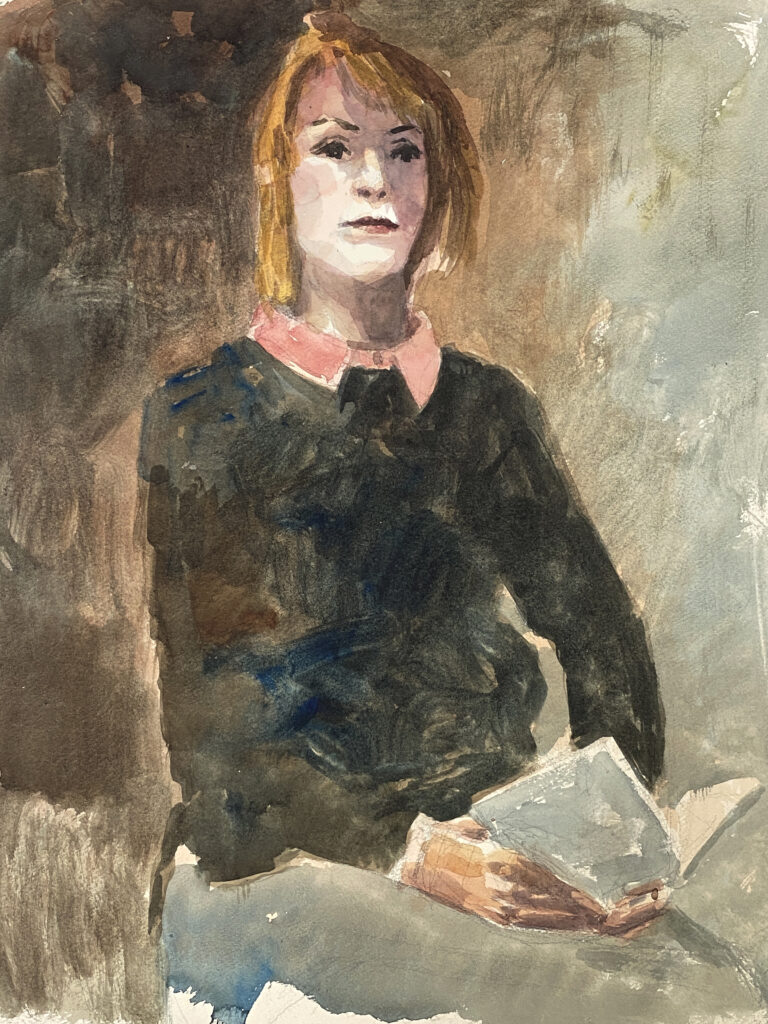
I decided to draw a person for the first time in a while.、I tried practicing using photos for the time being, but I haven't done it in a while.、The brush doesn't move as expected。After all, it is different from apples and potted trees.、Human expressions use a different brush stroke.、There seems to be an approach。It's difficult to be able to draw anything almighty.。
Even though it's a "new way of drawing"、in my own way、But。I'm a little tired today, so、That's it。
2I was finally able to upload the "outdoor sketch video" yesterday (January 8th), which has been pending for nearly a month.。I didn't drink alcohol on New Year's Day (although I did)、I didn't even eat mochi (although I did eat zoni), so I just ate this just because I was in the mood.。The content is very ordinary、There's nothing worth mentioning though、I made a lot of editing mistakes along the way (I guess it's because I read too much, right?)、The retouching process、Actually, I learned the most from it.。But、Oh dear、I felt like a weight had been lifted off my shoulders - it was truly Call it a day. 。
But、As soon as I uploaded it, I returned to reality.。10From now on, it's no longer YouTube.、Real “Blue Seagull Painting Class” begins。Is there an appropriate motif? Of course, the “appropriate motif” is different for each person.、physical、There are a lot of things that are unavailable at certain times.、Flowers and vegetables for now、I started looking for things that could be used as art supplies, such as fruits.。
People who draw apples (like me)、You don't necessarily have to draw an apple in front of you.。For example, in my case、Having a real apple in front of you is a ``disturbance''。Apples are an important motif for me.、I don't particularly want to trace its physical appearance.。For me, the only thing I need is the "internal" "tolerance (inclusiveness) power (form) of an apple."、After that, it would be better if the apple remained as a symbol.。
Many of the painters who present photographic realism、Actually, it's similar to me、I'm trying to portray the truth for that person, so to speak.、It seems that he is not trying to depict what is physically (optically) visible in front of his eyes.。In fact, when I hear that small and medium-sized painters, who seem to be completely removed from that, often say, ``My paintings are realistic.''、The general public may be surprised。The relationship between object and author is a surprisingly interesting theme.、Not only is it often taken up by novelists, etc.、Picasso and others relentlessly depict the relationship between ``painter and model.''。People who are convinced that “specific motif” = “object to be drawn”、In a sense, the motif may depict you "on the contrary".。 About the relationship between myself and the motif、It might be fun to think about it for a while。
I tried reshaping the idiom "step by step" to suit my own senses.。“One step” is surprisingly big (for me)、Half foot (half the length of the sole)、In terms of appearance, there are times when you can't even move forward as if you were ``sliding''.、I intended to include the meaning。(By the way、(I think it's an inappropriate phrase in English.)
I'm sorry for talking about the video every time.、As one YouTuber says, ``Most people who start YouTube fail.''。``This is because you won't make any progress in the first few months.''。Even if you try hard to make a video、There are days when the reaction is zero or close to it.、Even if the number of views increases slightly、When I receive negative comments, I get depressed and lose enthusiasm.、Apparently。
Fortunately? in my case、Until recently, I didn't really care about the number of views (I didn't have the luxury of doing so).。Practice making it for now。Upload what you made。I was 100% satisfied just being able to connect these two things.。Every time I remember one tiny technical thing like that,、I got a little joy。Is it an accumulation of small success experiences? ``Most people say something like 100,000 views.、Just look at the channel subscribers △ million people、I think it would be easy for me to do it," he said.、The reason I didn't take it seriously was because I thought, "That's impossible."、Maybe that's one of the reasons it's still going on。I explained it with various numbers and examples.、In a nutshell、It seemed like it was because I was trying to get results too quickly.。 Whether it's a video、Whatever it is、It is normal to not expect any (external) results at first.。But、Somehow I was able to do things that were difficult (for me).、It can take the form that suits it.、It's no longer a pain to take、Anyone can take a small step up as a response.。The accumulation of those small short steps makes a step.。actual、That's how everyone did it。
What is painful is、How much does it take to be a “step”?、I guess it's because we don't know how much time it will take.。One of the current American educational methods is 、Divide the step into as small as possible、It seems like it's about specifying a specific goal.。This educational method has produced many Nobel Prize winners.、I read somewhere that。 Good job if you can do this、Congratulations if you can do that too、Great! (amazing!)。(Japanese style) only look at the distant goal、It’s painful because I think, “This is not enough.”、It might be。let's educate ourselves。Praise yourself even if others don't praise you.。Let's prepare a reward too.。Divide Step into smaller steps、Start from a step from self-satisfaction.