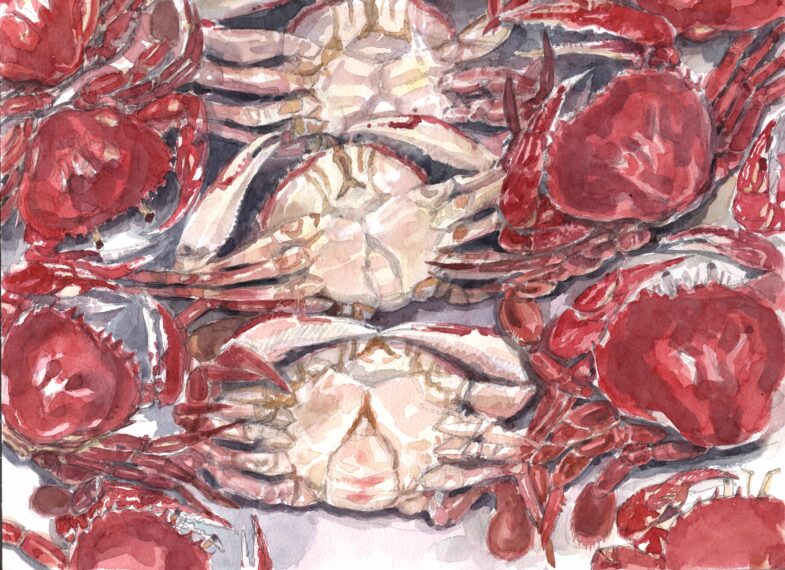
Shimokita Hiragani (Flounder crab) (watercolor sketch of boiled crab)
hot。Today (7/31) it will be ``dangerously hot'' at 38℃ in Kumagaya.。The fact that dangerous heat continues every day in various parts of the Kanto region means that、Kanto is already considered a dangerous zone (in summer).。So hot that people can't go outside to avoid the heat.、The workload of people working outside the home, such as in delivery services, will increase.。their、When I saw him wiping off his sweat and looking at his next delivery destination on his smartphone, he was trotting about.、I can't help but nod when someone says, "Civilization (equipment) progresses, but culture (society) does not progress that easily."。
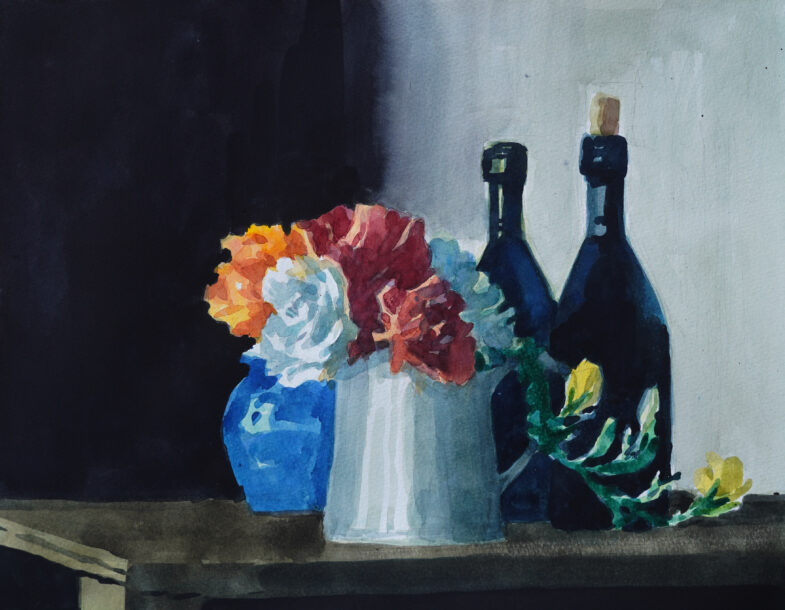
Recently、In the classroom, I often draw pictures based on photographs.。For one thing、Even if you go shopping with flowers as a motif,、Is it because of this heat and the lack of manpower due to corona?、This is partly because the condition of the flowers is not very good.。It takes several hours to find flowers.。Beautiful flowers are nice too、Avoid flowers that are difficult to draw.。While thinking of each person's face、This person wants to draw something like this、I guess the hurdles are a bit high for this person.、Round off your purchases while thinking about such things.。I don't have time to go shopping every day.、I want it to last at least a few days、Difficult to manage in this heat。
And that、Motifs such as flowers (only flowers are popular) are mostly sketches.。Based on that sketch、Attempts to add your own ideas and sense to create "works"、No matter how much I try, I can't get on board.。Most people started out thinking they could just draw sketches.、That's certainly consistent though。
The time spent actually moving the brush in the classroom is at most 2 hours.。for example、It took me more than twice that amount of time to sketch this crab.、Even if a student desperately draws for 3 hours in the classroom, it is impossible to finish the drawing in one time (although it depends on the drawing method)。Devote your time and energy somewhere other than the classroom、We have to break through the wall of “usual (everyday)”、I can't even make a sketch。This is also the purpose of using photographs.。But、The power to break through the “usual”、I guess it's just a love for drawing after all.。
Formerly represented at World Championships and Olympics、A sports commentator recently said this:。“The sports world、Even the taxes of people who don't play sports are used.、What can we give back to society?。If we don't think about this, people will turn away from sports."。
I can't understand your feelings, but、What I feel is a little dangerous is that ``Since we are using tax money, we have to give something back.''、Something similar to give and take。This part seems to resonate with many people in Japan these days.、If you think about it a little deeper, it could lead to the exclusion of socially vulnerable people by saying, ``I don't want people who can't (or don't think) to give it back to use it.''、Also for children's education、It may instill a sense of nationalist obligation to "return to the country in the future"、It is a sport that is firmly connected to the essence of current sports.。Of course, he didn't directly say that.、It contains a logic that can be interpreted as such.。When this ``return'' becomes ``something concrete,'' it becomes a statement such as ``It's meaningless unless it's a (gold) medal.''。
If you think like that, then、"What does art give back?"、かつてのロシアや現代の北朝鮮のような「国家に奉仕する」プロパガンダ絵画になる。「芸術は社会のカナリアだ」という人々がいる。確か、むかし炭鉱夫が坑内へ入るとき、酸欠状態かどうかを知るためにカナリアを先に入れたということが言葉の起源だったと記憶している。スポーツや芸術を認める社会がとりあえずは「安全」だ、というバロメーターとしてだけでも、すでに充分意味のあることだ。